Oct 16, 2026Applications & Industries
Quick Release Pins for Trailers and Tow Hitches: Fit and Load
How to select a quick release pin for a trailer or tow hitch: receiver pin sizes, usable span, shear vs retention, load ratings and RFQ evidence.
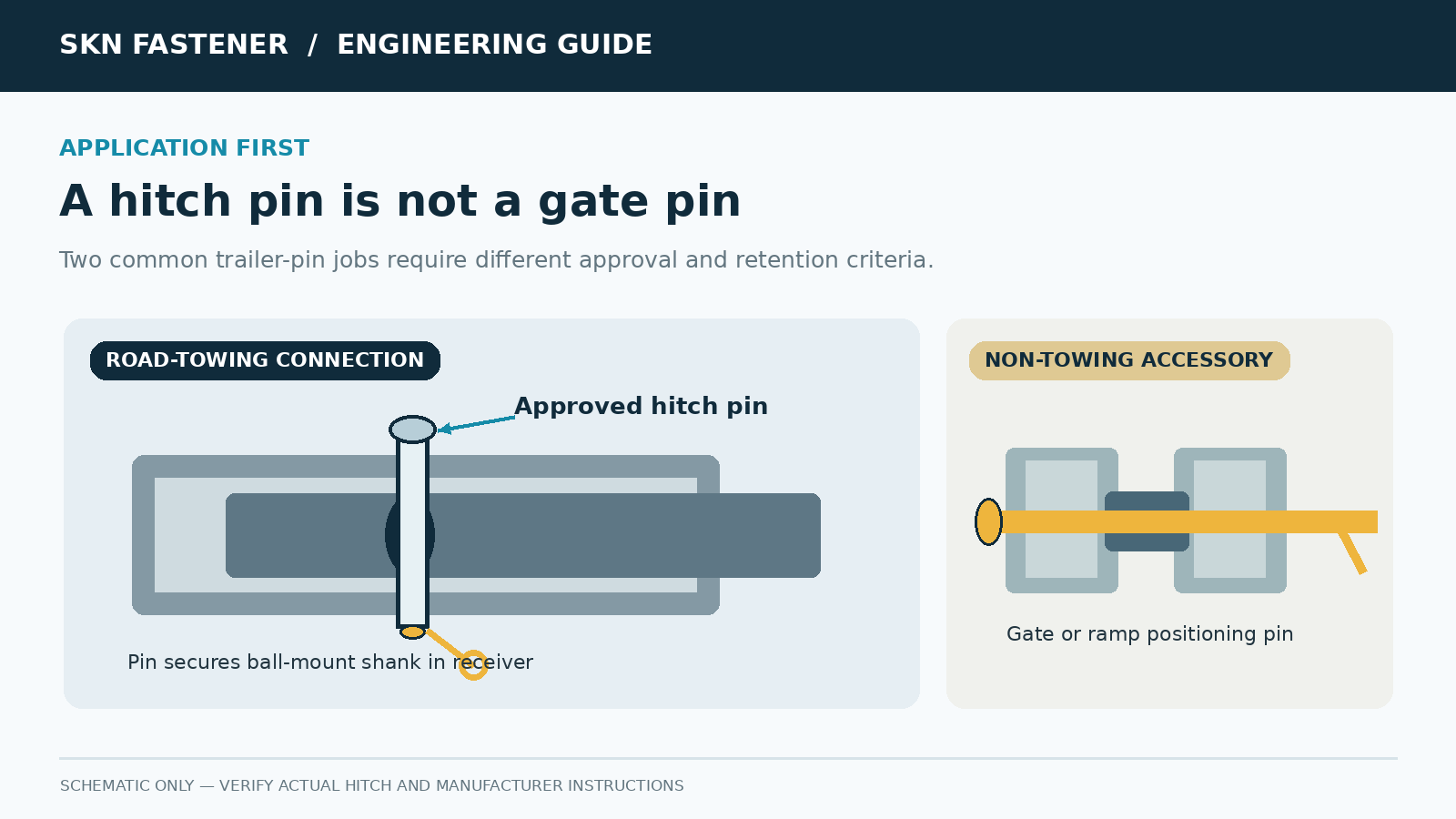
Choosing a quick release pin for a trailer looks simple until the hole is the wrong size, the retaining clip will not engage, or the pin has no verified towing rating. Those are not minor inconveniences. A loose or unsuitable connection can create a serious road hazard. The solution starts with identifying what the pin actually secures.
A quick release pin for a trailer must match the exact connection, not merely the hole diameter. For a road-going tow hitch, use a hitch pin or locking assembly specifically approved for that receiver and towing application. Verify pin diameter, usable span, retention method, and the manufacturer's capacity documentation. Do not substitute an ordinary ball-lock pin, spring detent pin, or untested quick-release component for a load-bearing towing connection. For gates, ramps, and other non-towing trailer accessories, the correct choice may be different.
I'm Jason from SKN Fastener, a China-based industrial fastener supplier established in 2010. Here is how I would review fit, loads, and supplier evidence before ordering trailer pins in bulk.
What Does “Quick Release Pin for Trailer” Actually Mean?
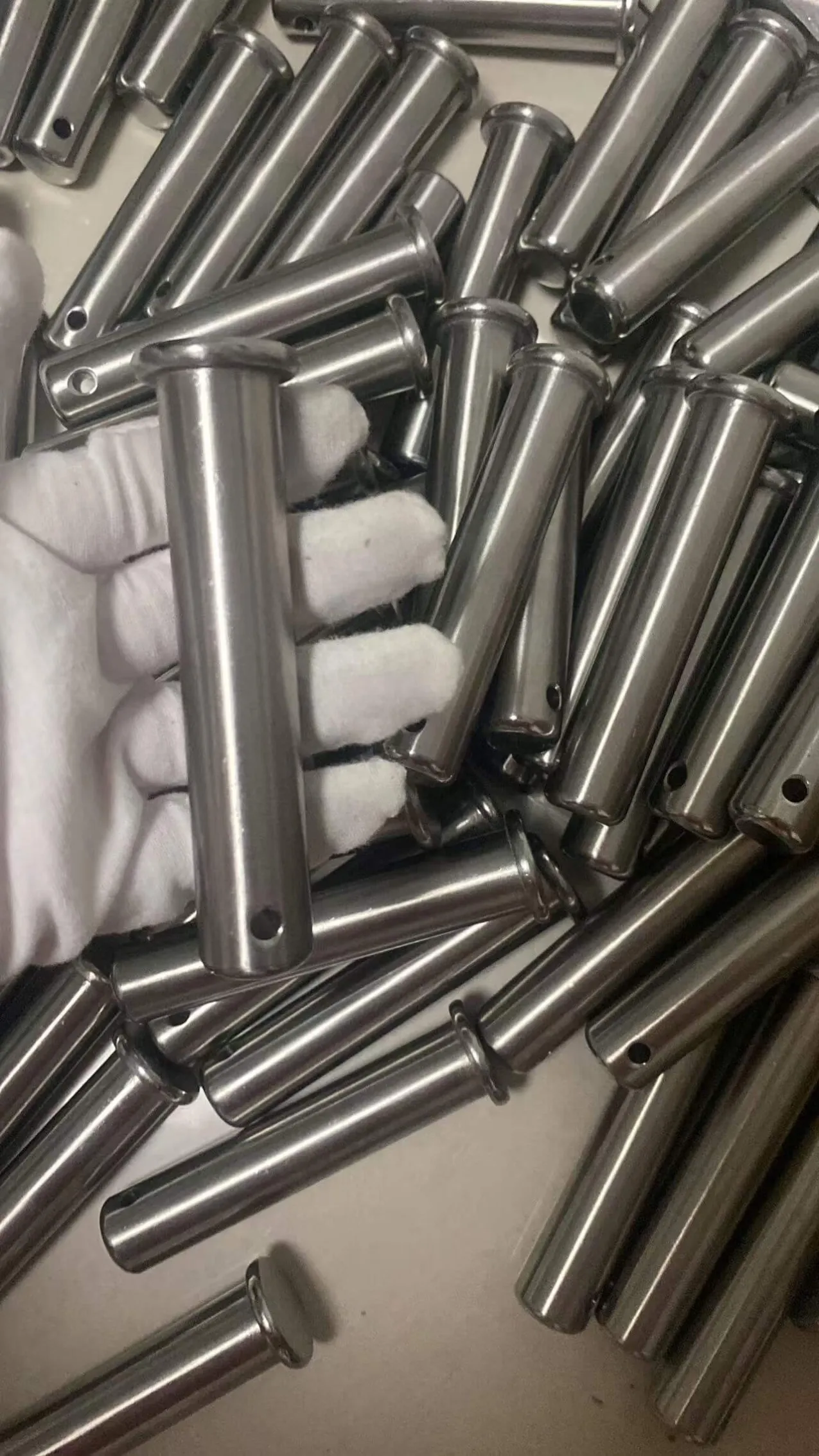
Buyers use this phrase for several different products. It might mean the hitch pin holding a ball mount inside a vehicle's receiver, a pin securing a trailer ramp, a removable gate hinge, or a quick-change pin on a trailer accessory. These are not interchangeable jobs.
In this guide
# | Section |
|---|---|
1 | What Does “Quick Release Pin for Trailer” Actually Mean? |
2 | Can Any Ball Lock or Quick Release Pin Be Used in a Tow Hitch? |
3 | Which Hitch Pin Sizes Fit Common Trailer Receivers? |
4 | How Do You Measure Pin Diameter, Usable Span and Hole Alignment? |
5 | What Load Ratings Matter for a Trailer Hitch Pin? |
6 | How Are Shear Load and Retention Different? |
7 | Which Locking Mechanism Is Appropriate for Road Towing? |
8 | Which Materials and Coatings Work Best Outdoors? |
9 | How Do You Check a Hitch Pin Before Towing? |
10 | What Should OEM Buyers and Wholesalers Ask a Trailer Pin Supplier? |
11 | What Mistakes Should Buyers Avoid When Ordering Trailer Pins? |
12 | How Should You Prepare a Trailer Pin RFQ? |
13 | Conclusion |
The first distinction is between road-towing connections and non-towing accessories. A receiver hitch pin may be part of the connection between the tow vehicle and its ball mount. A ramp pin may only secure a ramp while the trailer is parked. The resulting load conditions, locking requirements, and consequences of failure are entirely different.
Pin application | What it does | Selection priority |
|---|---|---|
Receiver hitch pin | Retains the ball mount or accessory shank in a hitch receiver | Approved towing use, diameter, span, positive retention and system rating |
Coupler latch pin or lock | Secures a coupler's latch mechanism | Coupler-manufacturer compatibility; never substitutes for correct coupling |
Trailer ramp or gate pin | Holds a movable accessory in position | Mechanical fit, vibration resistance and application load |
Removable fixture or cargo accessory pin | Positions or retains a detachable component | Defined operating load, locking design and duty cycle |
If a seller only advertises “trailer quick release pin” without specifying which connection it serves, I would not proceed to price negotiation yet. I would request an application drawing or photographs showing both the pin and the parts it retains.
Can Any Ball Lock or Quick Release Pin Be Used in a Tow Hitch?
No. A pin that slides into a hitch hole is not automatically suitable for highway towing. Standard ball-lock and detent pins may be designed for positioning or frequent tool-free removal, with retention and load data that do not address road-towing demands.
For the main receiver connection, follow the hitch and vehicle manufacturers' instructions and use a pin or lock specifically approved for that receiver and intended towing duty. A small ball-lock pin used successfully on a workshop fixture is not a valid substitute. Likewise, do not modify a rated hitch pin or improvise a clip to make a mismatched part fit.
This is also why I separate shear capacity, axial retention, and complete towing-system ratings in every technical discussion. Evidence for one is not proof of the others. If a design requires an unconventional quick-release mechanism, it needs qualified engineering evaluation and application-specific validation before road use.
Which Hitch Pin Sizes Fit Common Trailer Receivers?
Pin size is frequently confused with receiver opening size. A 2-inch receiver does not use a 2-inch-diameter pin. The opening describes the square receiver tube; the pin fits the cross-hole through the receiver and insert.
For illustrative, manufacturer-documented examples, CURT lists a 1/2-inch pin with a 5/8-inch adapter for certain 1-1/4-inch and 2-inch receivers, and a 5/8-inch hitch pin for a 2-inch receiver. Its guidance for 2-1/2-inch receivers also specifies a 5/8-inch-diameter pin. These are examples, not a universal interchangeability guarantee. Always verify your exact hitch model and product instructions. CURT 1/2-inch pin with adapter; CURT 5/8-inch hitch pin; CURT 2-1/2-inch receiver guide.
Nominal receiver opening | Diameter seen in manufacturer examples | What to confirm |
|---|---|---|
1-1/4 in | 1/2 in | Specific receiver hole and approved retaining hardware |
2 in | 5/8 in; some approved adapter systems differ | Hitch manual, pin/lock design, accessory shank |
2-1/2 in | 5/8 in in cited CURT guidance | Usable pin span and receiver wall thickness |
3 in | Product-specific; some 5/8-in heavy-duty models | Approved pin model, span, and towing rating |
The nominal diameters above are not manufacturing tolerances or a universal fit chart. Hole dimensions, hitch construction, insert geometry, and special adapters must be checked separately.
How Do You Measure Pin Diameter, Usable Span and Hole Alignment?
I recommend measuring the complete connection rather than copying the old pin's length. Start with the cross-hole diameter in the receiver and shank, then measure the total width the pin must cross. Include both receiver walls and the inserted part, plus any approved accessory arrangement.
The pin needs enough usable span for its locking clip, swivel retainer, or lock body to sit outside the receiver and engage fully. Overall length is not the same as usable span. On a ball-lock design, the manufacturer's defined grip length may be measured between the head and the locking balls; on a conventional hitch pin, the relevant geometry may be different.
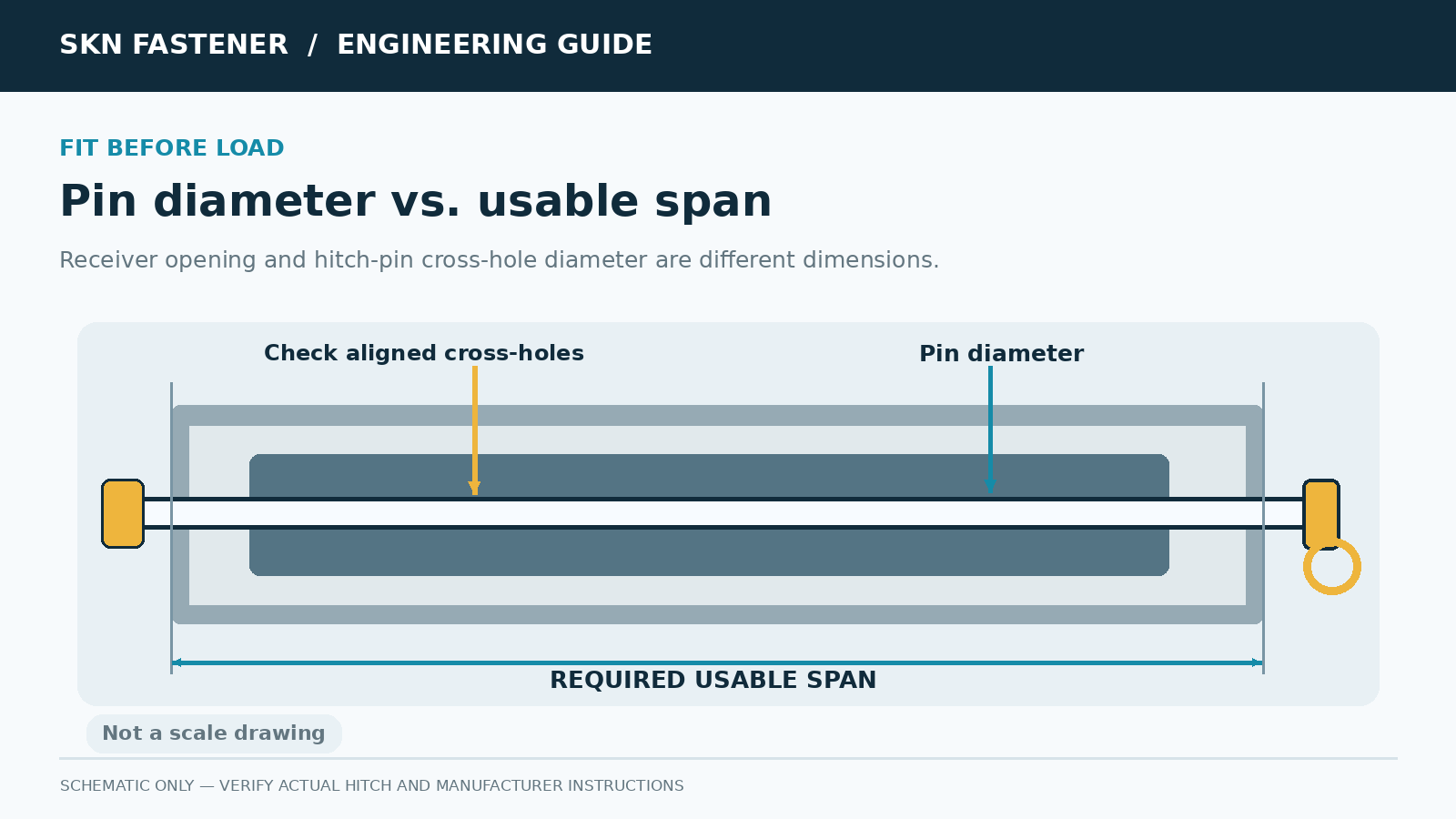
For a buyer's drawing, I would ask for shaft diameter with tolerance, overall length, usable span, location of the retainer groove or hole, head geometry, and the mating-hole specification. Check that the holes line up without forcing the pin. If the pin will not seat or the retainer cannot fully engage, do not tow until the mismatch is resolved.
What Load Ratings Matter for a Trailer Hitch Pin?
First identify the ratings of the complete towing system. These may include gross trailer weight (GTW), tongue weight, vehicle towing capacity, receiver rating, and the ratings of the ball mount and other towing components. The usable limit is constrained by the weakest applicable component and the vehicle manufacturer's instructions.
A manufacturer may publish a towing rating for a specific hitch-pin product. For example, CURT describes one particular heavy-duty 5/8-inch hitch pin for 3-inch receivers as tested and rated for 21,000 lb GTW. That number belongs to CURT's specified model and must not be copied onto another 5/8-inch pin or attributed to SKN. CURT product example.
Rating or property | What it describes | What it does not establish |
|---|---|---|
Gross trailer weight rating | Rated combined trailer weight for a defined component/system | A universal pin shear strength |
Tongue weight rating | Permissible vertical load on an applicable towing component | Total trailer weight |
Pin shear strength | Resistance under a defined shear test or calculation | Approval for an entire towing system |
Axial retention or pull-out force | Resistance to withdrawal in a specified test | Hitch suitability under road vibration and multi-axis loading |
Ultimate failure load | Load at which failure occurs under a test definition | Automatically allowable working load |
A practical rule is to reject quotations that show an impressive number without explaining what was tested, the sample geometry, test procedure, and whether the value is a working limit or failure value. A load rating without a definition is a marketing claim, not engineering evidence.
How Are Shear Load and Retention Different?
A pin passing through a receiver and ball mount can experience forces in more than one direction. The pin's shaft may resist transverse loading, while its retaining clip or locking mechanism prevents unintended axial withdrawal. One function does not replace the other.
Simplified double-shear models can be useful during engineering review, but a real hitch connection also involves hole clearance, bending, wear, impact, and the behavior of surrounding steel parts. The towing system cannot be approved by calculating a pin's cross-sectional area alone.
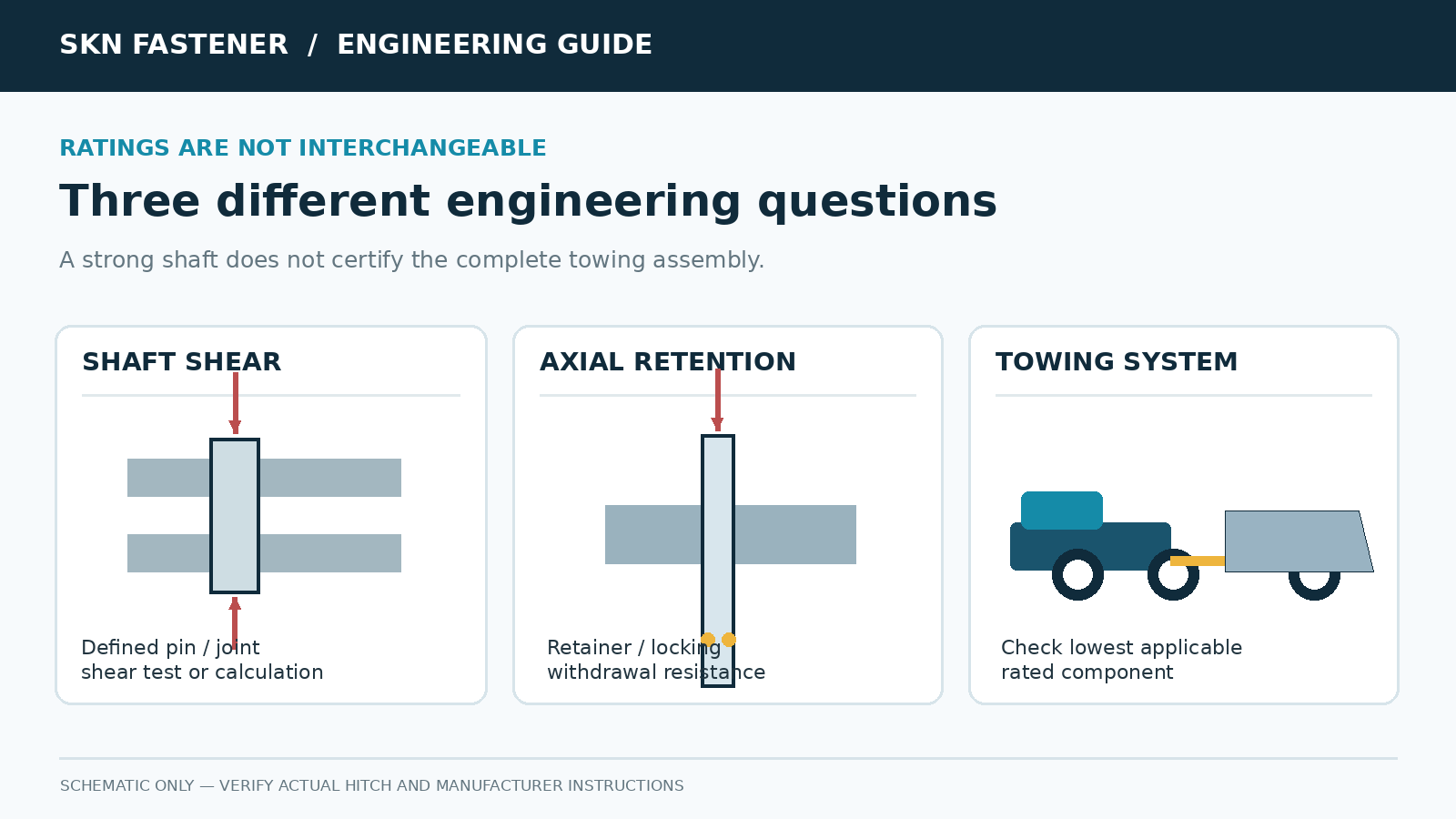
I would ask for product-specific test evidence and a clear explanation of the intended load path. For a safety-related hitch application, a missing or uncertain retention specification is a reason to stop, not a reason to assume that a larger shaft will solve everything.
Which Locking Mechanism Is Appropriate for Road Towing?
Common towing-specific options include a conventional hitch pin with a properly installed retaining clip, a manufacturer-approved swivel-retainer design, or a hitch lock intended for the particular receiver. These products can be quicker to operate than threaded hardware without relying on an unverified industrial quick-release mechanism.
Before approval, I check that the retaining feature cannot disengage during expected vibration, that it clears nearby structures, and that it remains accessible for inspection. A theft-deterrent lock is not necessarily a higher-capacity hitch pin; its towing suitability must still be verified independently.
Do not confuse a coupler latch lock with the receiver hitch pin. The former acts on the trailer coupler's latch; the latter retains a component in the vehicle receiver. Both need to be correct, and one cannot compensate for an improperly secured or incompatible component elsewhere.
Which Materials and Coatings Work Best Outdoors?
Trailers face rain, road spray, grit, and sometimes saltwater. Materials and coatings matter, but corrosion resistance is only one element of suitability. A stainless steel pin may resist corrosion well yet have different mechanical properties from a hardened or alloy-steel product.
For outdoor procurement, I compare the specified steel grade, heat treatment if any, coating, corrosion-testing evidence where required, and compatibility with the surrounding components. I also check the retaining clip or lock mechanism, not just the visible pin shaft.
A common mistake is selecting a component labeled “marine-grade” or “stainless” and assuming it is towing-rated. Those descriptions do not establish the load rating. Ask the supplier for both material traceability and application-specific performance documentation.
How Do You Check a Hitch Pin Before Towing?
Installation instructions from the vehicle and hitch manufacturers take precedence. At a minimum, the correct pin must pass through aligned holes in the receiver and insert, and its clip or locking mechanism must be fully secured. Do not use a pin that is bent, excessively worn, corroded, modified, or visibly damaged.
Then inspect the whole connection: confirm the correct ball and coupler engagement, attach safety chains as required, check electrical connections and trailer brakes where applicable, and respect towing and tongue-weight limits. These checks are separate from verifying the pin itself.
The U.S. Federal Motor Carrier Safety Regulations include particular requirements for coupling devices and safety devices in covered commercial combinations; they are not a blanket product certification for generic quick-release pins. See 49 CFR §393.70. The broader industry standard SAE J684 addresses automotive-type trailer couplings, hitches and safety chains within its stated scope.
What Should OEM Buyers and Wholesalers Ask a Trailer Pin Supplier?
For bulk sourcing, I would create two distinct specifications: one for road-towing-approved hitch pins, and another for trailer accessories such as gates and ramps. Otherwise, a quote can appear competitive while leaving the intended load path unresolved.
Before ordering, send the supplier a request for quotation (RFQ) with the intended application, approved mating-hardware drawings, diameter and span, quantity, material and coating, packaging, and the relevant test and document requirements. If the pin will be used on-road, also identify the precise vehicle/hitch compatibility and evidence required for towing approval.
Supplier evidence | Why I ask for it |
|---|---|
Part drawing and revision | Prevents silent dimensional changes |
Material specification and batch records | Supports traceability |
Defined inspection criteria | Allows objective acceptance |
Towing approval or model-specific rating, if applicable | Separates rated hitch hardware from generic pins |
Retention and functional test results | Evaluates the specified locking feature |
Sample approval and production-change procedure | Reduces inconsistency between samples and orders |
Packaging, lead time, and dispute terms | Protects commercial execution |
At SKN Fastener, we work in the industrial fastener and precision-component sector. I would not represent a custom pin as suitable for road towing without verified specifications, appropriate validation, and approval for that use. We can start a technical discussion from the buyer's drawing and the intended application.
What Mistakes Should Buyers Avoid When Ordering Trailer Pins?
The largest mistakes are easy to prevent: ordering by a photograph, treating receiver size as pin diameter, confusing overall length with usable span, and accepting “heavy duty” without a defined rating. Another frequent problem is overlooking the clip or locking mechanism when evaluating the shaft.
Most importantly, do not transfer a third-party product's GTW rating to a similar-looking pin. Even if the diameter matches, material, heat treatment, geometry, retention, manufacturing controls, and qualification may be different. A generic ball-lock pin is not a towing component merely because it can be inserted into a hitch hole.
How Should You Prepare a Trailer Pin RFQ?
A clear RFQ saves time for both the buyer and the manufacturer. I recommend specifying the intended connection first, followed by drawings, the receiver and mating-hole dimensions, minimum and maximum required span, retention style, expected quantities, environmental conditions, and validation documents.
Trailer pin procurement checklist:
# | Procurement checklist item |
|---|---|
1 | Define whether the pin is for the on-road hitch connection or a non-towing accessory. |
2 | Identify vehicle, receiver, ball-mount, or trailer-accessory models. |
3 | Confirm required pin diameter and usable span from approved documentation. |
4 | Verify full engagement of the specified clip or locking mechanism. |
5 | Obtain the correct product-specific rating and test definition for road towing. |
6 | Check complete system towing and tongue-weight limits. |
7 | Confirm material, coating, dimensions and production traceability. |
8 | Review representative samples, inspection requirements, and batch controls. |
9 | Agree on packaging, delivery, and change-notification procedures. |
Good procurement questions do not slow a project down. They prevent the expensive kind of speed: the rush to replace an unsuitable part after it has already shipped.
A quick release pin for a trailer must be selected by application, fit, retention, and verified load requirements. Never substitute an unrated pin for a towing connection. Need industrial trailer-accessory pins or custom fasteners? Contact SKN Fastener with your drawings and specifications.